I have been considering holding either on-site or YouTube/Rumble training classes on basic, hand-tool woodworking, something for people who want to get started in it, but who don’t have a dedicated space they can use (i.e. they don’t have a shop). I would set it up so they could use a kitchen or dining room table or outdoor picnic table to work on, and have a simple set of relatively inexpensive tools to get started. I would also have them create some of the tools themselves, both to save money and to help build skills.
One of the basic tools you can build would be a mallet. You can purchase these for $30 on line, but if you build it yourself you will save money and learn something. The mallet is based off a plan in the book Tool Making Projects by Steve Olesin. Use a hardwood like Beech, Cherry or Maple.
Tools needed:
- Marking Knife
- Combination Square
- Crosscut saw
- File/Rasp
- Block Plane
- Bit & Brace or Drill
- Hammer
- Sandpaper & Sanding Block
- Four (4) clamps
- Wood Glue (Titebond I is good)
Jigs Used (more posts in future on how to build)
- Saw Hook
- Bench Block
So the process starts with purchasing a ¾” thick, 3” wide board, 36” long. Layout to cut three 6” lengths (for the head) and one 12” length (for the handle). Use your combination square and marking knife to layout and prep for the saw. Use the crosscut saw to cut the pieces to length on the saw hook.


Mark out a 5 degree angle on one of the 6” lengths of wood, and then saw that into two separate blocks. This will be used to hold the slip handle. Glue the two pieces to one of the other 6” pieces, lining them up to create a “funnel” where the top is roughly 2” open on top and only 1-1/2” open at the bottom. This will allow the handle to slip in/out as needed.

With that done, you can lay out the handle. Measure 2/16” on top of handle and then 3-3/4” down, measure to 1-1/2”. Use the ruler to put this two points together (this will be what “seats” in the head). Carry the 1-1/2” measurement down the rest of the handle to the end.

Now use the block plane and your file/rasp tool to take wood off the handle. As you get closer to the line, take the head out of the clamps (glue should be dry after 1 hour) and keep testing it in the head until it seats correctly and you have something around ¾” of the handle still sticking above the mallet head. Once that work and you have tested it by putting the third part of the head on top, you can glue it up and use clamps. Pull out the handle while doing this, so it doesn’t get glued into the head.


The mallet head needs to have a bit of an angle, so that as you use it, the blow is square. To figure out the angle, use your straight edge to measure from the top corner of the head to the bottom of the handle. Use a pencil to show this line on both sides of the head, then use a knife to create a line for your saw. Cut the head to shape, using the saw hook.


To further reinforce the head and keep it from falling apart, drill two 3/8” holes through the head, using a bit and brace, angling them somewhat away from each other (so it keeps the head together). Take 3/8” dowels, glue them up, and insert them into the head. Once the glue dries, use saw, chisel, and sandpaper to cut them off and clean them up.


You can use your file/rasp to further refine the handle, rounding over the edges where the hand will sit. Most folks leave the bottom 1” and the 1” before the mallet head square. Use sandpaper to further clean up and ease the corners of the handle and the mallet head as well.
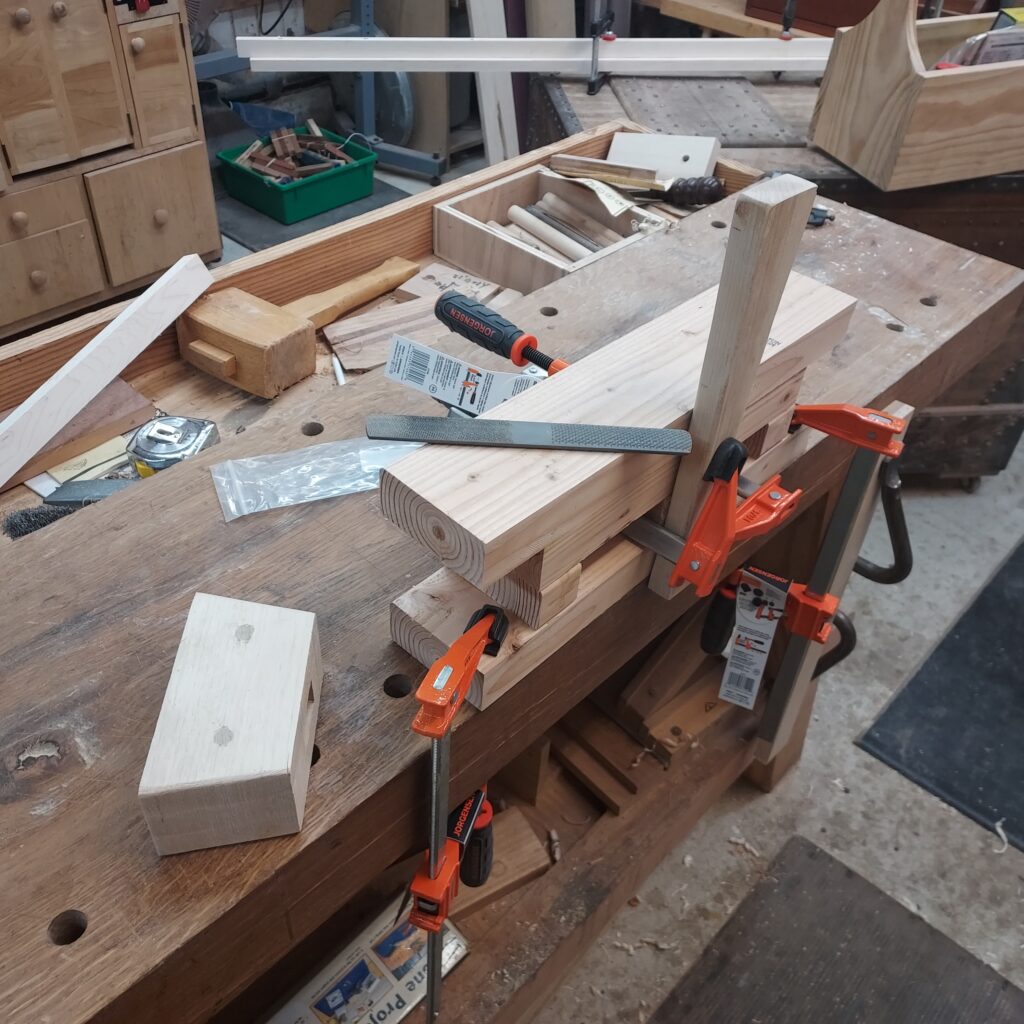
Now you have a mallet you can use with your chisels or to help seat joinery when it is a little tight!

Kevin